
Circular Economy Pre-Demolition Audits and Pre-Redevelopment Audits are also known as Pre-Deconstruction Audits and Pre-Refurbishment Audits.
They support design analysis that fully explores options for retaining existing structures, materials, and the fabric of existing buildings in the new development.
These audits will also assist in considering the refurbishment of buildings as opposed to undertaking substantial demolition.
An independent third party should undertake Circular Economy Pre‑Demolition and Pre‑Redevelopment Audits early during RIBA stage 2/3. These audits then inform the design.
GLA Circular Economy Statement Requirements
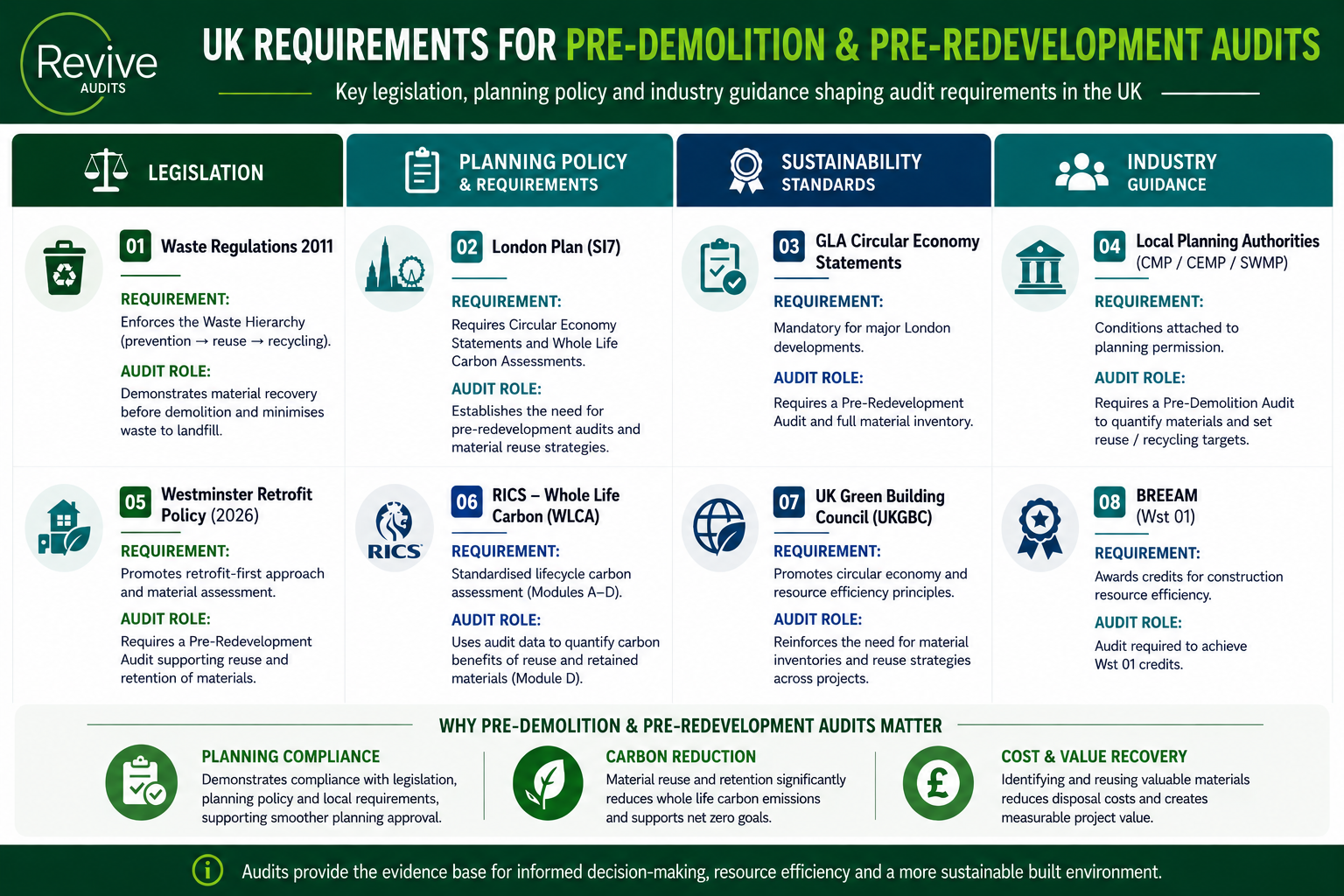
In March 2022, the Greater London Authority (GLA) released the London Plan Guidance Circular Economy Statement. This explains how to prepare a circular economy statement prior to submitting a planning request.
This document includes guidance on how the design of new buildings and the redevelopment of existing structures can promote circular economy outcomes.
Therefore, all developments are required to aim for high sustainability standards and to take into account the principles of the circular economy.
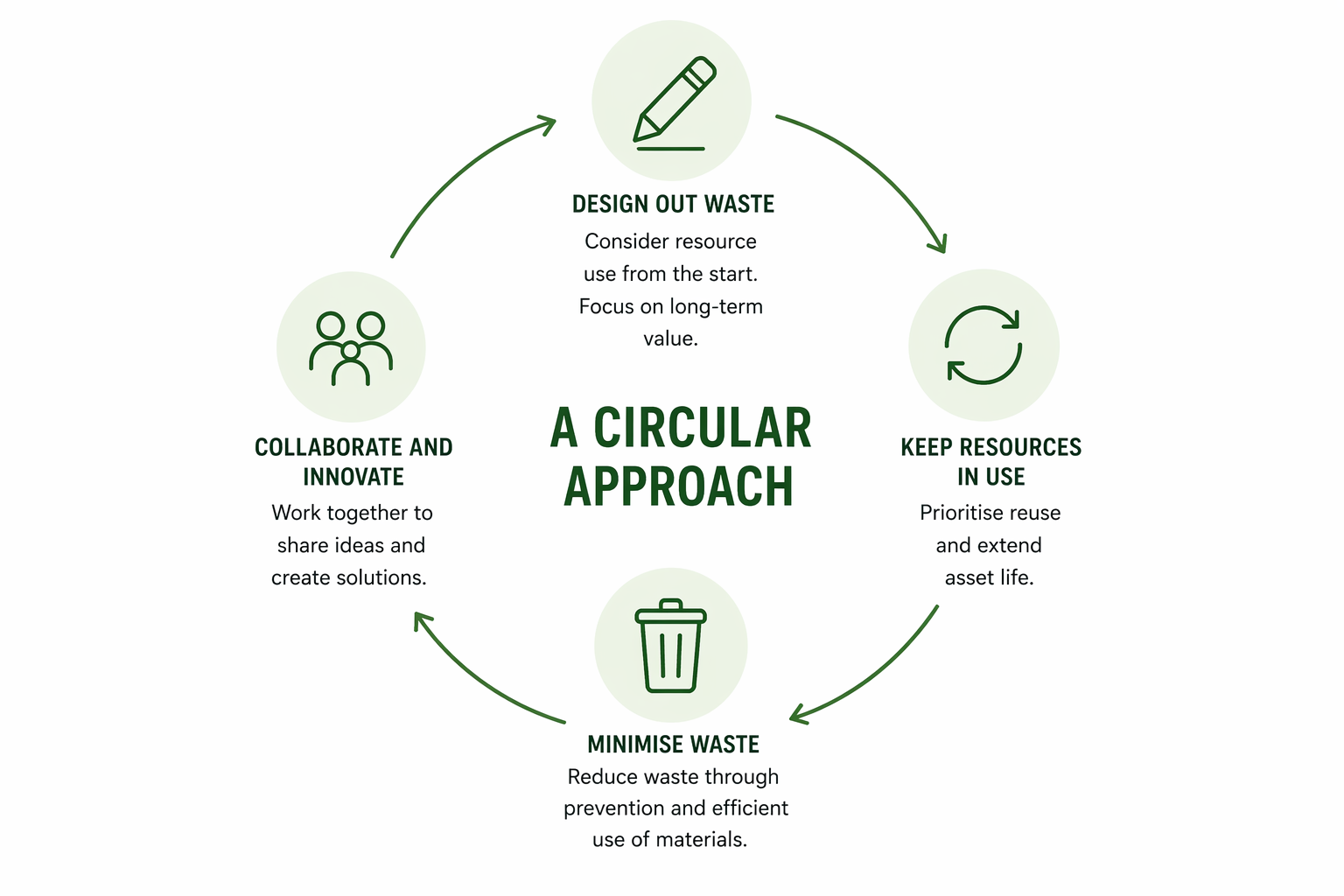
The Circular Economy Guidance (CE) has 6 principles, which should be a fundamental part of the building design process.
These are:
Purpose of a Pre-Demolition and Pre-Redevelopment Audit
Circular Economy PDAs and PDRAs are undertaken with the key goal of maximising the recovery of Key Demolition Products (KDPs) and diverting materials from landfill by following the order of the waste hierarchy.
These audits include a detailed inventory of internal and external Key Demolition Products (KDPs) and building fabric (excluding furniture).
They also provide estimations of weights, volumes and also end-of-life embodied carbon within those materials identified.
The Pre-Demolition and Pre-Redevelopment Audit Process
During the audit, a non-intrusive investigation of the internal and external areas of the site is undertaken, using appropriate measuring tools.
Information received before the audit will also be reviewed, which can include original architect drawings, demolition plans or structural drawings.
This information is collated within Revive's bespoke software to provide estimated weights, volumes and end-of-life embodied carbon of Key Demolition Products (KDPs).
This will include the building structure, roof and internal fabric, as well as external elements like hard-standing surfaces, walls and fences.
For Pre-Redevelopment audits, these assessments are undertaken as per the proposed scope of redevelopment or refurbishment works, as opposed to the demolition of the whole building.
Working in accordance with the BRE Pre-Redevelopment Waste Audit Code of Practice and GLA Circular Economy Statement, Revive will incorporate the following steps within the PDA:
This will in turn support the principle contractors site waste or resource management plan in managing materials from the demolition/refurbishment process and ensuring recovery is in line with the waste hierarchy.
In addition, the embodied carbon data provided within the report can be incorporated into the project's Whole Life-Cycle Assessment.
This sets out the principles of the environmental impacts of built projects and should demonstrate the actions that have been, and will be, taken to reduce carbon emissions.
For further information or to receive a quotation, contact Revive Audits to discuss your project.